

Two laptops, two price lists, and a decision that usually gets made on a sticker price. This n8n vs Zapier for small business guide does the arithmetic instead: 2026 list prices, how each platform meters your work, what one AI step really costs you, and what self hosting n8n adds to your calendar as well as your invoice.
I build automations for clients, mostly n8n and plenty of Zapier, so every example here is a workflow a small business actually runs: lead capture, order alerts, invoice chasing, support triage. I will also tell you where I would pay Zapier’s bill, including the cases where n8n is cheaper.
Choose Zapier if nobody in the business reads API documentation, your apps are niche SaaS tools, and you want a workflow running this afternoon. One seat on Professional is $19.99 a month billed yearly for 750 tasks.
Choose n8n if the same logic runs thousands of times a month, needs loops, retries or an AI agent, or you want customer data on your own server. Cloud starts at $20 a month for 2,500 full runs of any length, and the Community Edition has no licence fee and no execution ceiling.
Neither yet if the workload is a few hundred simple runs a month. One two-step Zap on the Free plan covers that.
What this guide covers
- The short version, in one table
- Why the meter matters more than the price
- How Zapier counts tasks in 2026
- How n8n counts executions and where it stops
- What the same workload costs at three volumes
- The seat limit that changes the shortlist
- The integration count is a weak reason to choose
- AI work, where the two tools stop looking alike
- Who owns it at 9pm
- Self hosting n8n is free software, not a free project
- What it costs to have it built and kept running
- Running both tools is a normal answer
- Three questions that settle it
- Common questions about n8n vs Zapier for small business
- How to test this without paying for a year
The short version, in one table
| Question | Zapier | n8n |
|---|---|---|
| Unit you are billed for | Task, one per successful action step | Execution, one per whole workflow run |
| Apps and connectors | 10,247 in its directory, October 2026 | About 400 native nodes, more from the community |
| AI steps | 1, 3 or 5 tasks depending on model tier | No platform charge, you pay the model provider |
| Builder difficulty | Guided, most ship on day one | Canvas plus JSON, a few evenings |
Why the meter matters more than the price
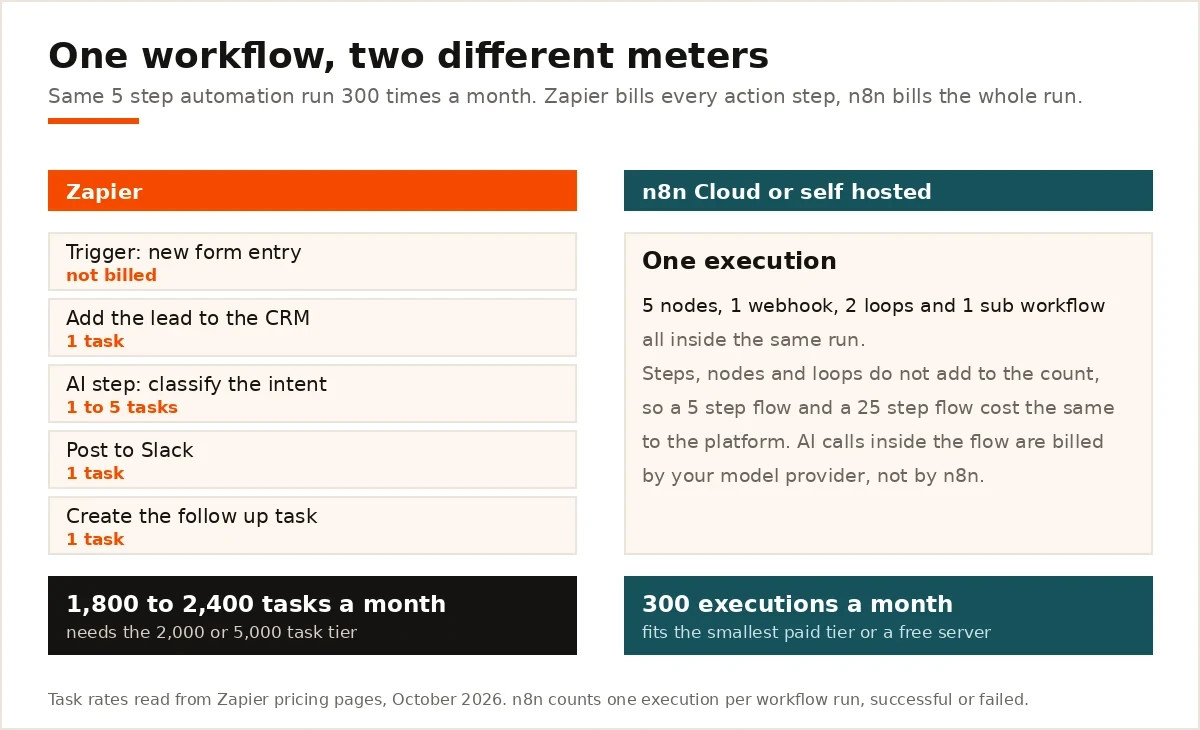
Both tools publish a starting price near $20, and that coincidence fools a lot of buyers. The difference is what the price buys. Zapier sells tasks, where a task is one successful action step. n8n sells executions, where an execution is one complete run, four nodes or forty.
For a two-step automation the models land close together. For a six-step flow with a loop and an AI call, Zapier’s counter moves six to ten times faster on the same work. Everything below follows from that.
How Zapier counts tasks in 2026
Zapier moved AI, code and its SDK onto one task model this year, so usage now behaves the same everywhere in the product. The published rates, read from its pricing pages in October 2026, fit on a whiteboard.
| What runs | Tasks charged |
|---|---|
| Standard action step, for example add a CRM record | 1 |
| Triggers, Filters, Paths, Formatter, Delay, Loops, Tables, Forms | 0 |
| Code step, and each 30 seconds of extended runtime | 1 each |
| AI step on standard or bring-your-own model | 1 |
| AI step on an advanced model | 3 |
| AI step on a premium model, and each tool call it makes | 5 each |
| MCP tool call from Claude, ChatGPT or Cursor | 2 |
Two rows deserve attention. Branching, filtering and formatting never touch your counter, which is why many Zaps cost less than they look. The premium AI row is where teams get surprised, since an agent that reasons over an inbox and calls three tools burns sixteen tasks per run by itself.
What the Free plan really gets you
Free is 100 tasks a month, forever, for one user, with unlimited Zaps as long as each stays at two steps. Polling runs every 15 minutes, and premium apps, webhooks, Filters and Paths are out.
The 14 day Professional trial is the better sandbox, since it lifts you to 1,000 tasks and opens up multi-step work. Judge the tool there, on your real process.
How n8n counts executions and where it stops
n8n bills one execution per run, trigger to finish. Loops, sub-workflows, code and AI nodes inside that run add nothing to the count. Failed runs still consume one, so a workflow that fires every five minutes and achieves nothing still costs you.
| n8n Cloud plan (2026, annual billing) | What you get | Where it bites a small business |
|---|---|---|
| Starter, $20 a month ($24 monthly) | 2,500 executions, 1 shared project, 5 concurrent | Runs stored 7 days, 5 minute ceiling |
| Pro, $50 a month ($60 monthly) | 10,000 executions, 3 shared projects, 50 concurrent | No custom nodes, forum support only |
| Business, $800 a month | 40,000 executions, SSO, Git, environments, queue mode | Self-hosted only, Cloud via a waitlist |
| Enterprise, quote only | Unlimited projects, 200 plus concurrent, 365 days of insights | Priced for governance, not a small shop |
Concurrency is the number nobody reads. Starter runs five executions at once, so a burst of two hundred orders queues instead of processing. Pro lifts that to 20 or 50 and allows a 40 minute runtime, which is what lets a bulk sync finish at all.
The ladder taxes growth. Past 2,500 executions the next stop is $50 a month, then $800. The Start-up Plan takes 50% off Business for companies under 20 employees, the only way that tier is reachable for a small shop.
What the same workload costs at three volumes
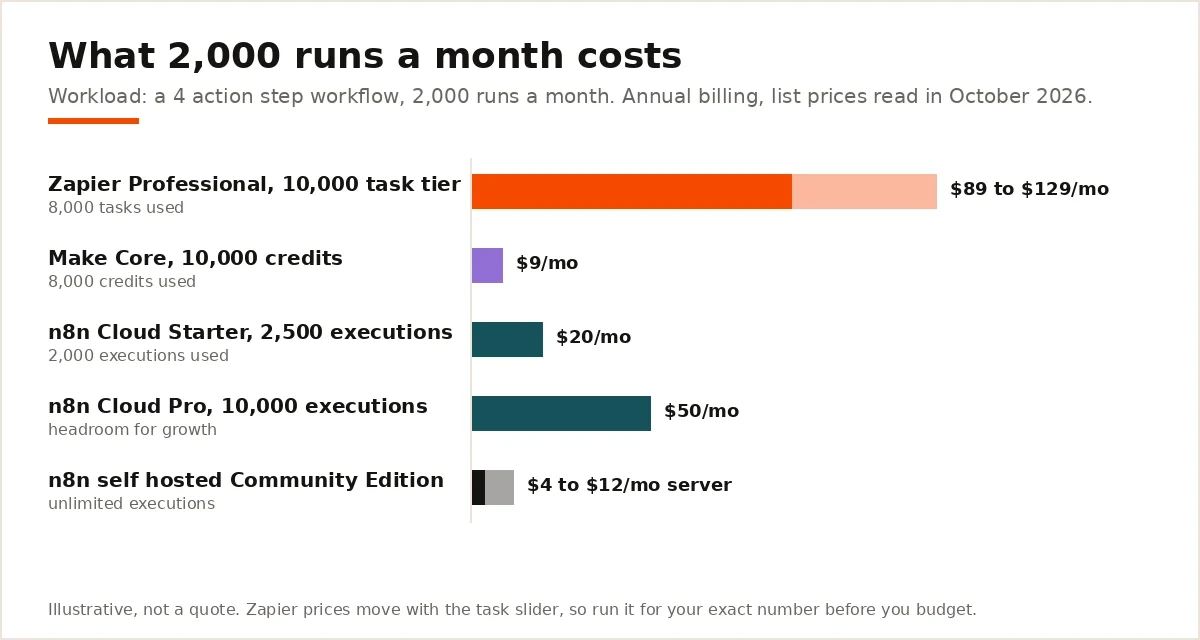
Three workloads, priced at vendor list rates on annual billing, with Make as the middle option. Read them as orders of magnitude: both ladders move, and your exact tier is a two minute job on their sites.
| Workload | Zapier | n8n Cloud | Make or self-hosted n8n |
|---|---|---|---|
| Form to CRM to Slack, 300 leads a month, 2 action steps | 600 tasks, $19.99 a month | 300 executions, $20 a month | Make Free covers it; a $6 server covers n8n |
| Order operations, 2,000 runs a month, 4 action steps, loops | 8,000 tasks, roughly $89 to $129 | 2,000 executions, $20 a month on Starter | Make Core $9; self-hosted n8n $4 to $12 plus your time |
| Support triage with a premium AI model, 1,000 tickets, 7 tasks or 1 execution each | 7,000 tasks, $129 or more, plus model costs are inside that price | 1,000 executions, $20, and you pay OpenAI or Anthropic separately at per-token rates | Self-hosted n8n $4 to $12 plus the same model bill |
At 300 runs a month the tools cost the same. At 2,000 runs of anything multi-step, n8n is five to six times cheaper on subscription. In the AI row Zapier’s number includes model access and n8n’s does not, so put your API invoice beside both before you crow.
The seat limit that changes the shortlist
Zapier Free and Professional are one-seat plans. Two users is where Team starts, at $69 a month billed yearly for 25 seats, or $103.50 monthly. n8n lists unlimited users on every Cloud plan, but access is not sharing.
A three-person team gets an awkward choice: pay $69 for shared Zaps, share one login badly, or self-host n8n and keep workflows siloed until you buy up the ladder. If two of those make you wince, budget for seats before the tool debate.
The integration count is a weak reason to choose
Zapier listed 10,247 apps across 15 categories when I read its directory in October 2026, while n8n ships around 400 native nodes plus community ones. That gap is real for niche SaaS and smaller in practice than it sounds.
Two questions decide whether it applies to you. Do the apps at the centre of your workflow have official n8n connectors? If yes, count the long tail as a tie. Can someone you pay configure a REST call with an API key and a JSON payload? If yes, n8n’s HTTP Request and Code nodes reach almost anything documented.
Gating matters more than the count. Premium apps such as Salesforce, HubSpot and Facebook Lead Ads need a paid Zapier plan, and a Zap using one stops the day your trial ends. Every n8n node is included on every plan, the free Community Edition too.
AI work, where the two tools stop looking alike
Zapier gives you Agents on their own activity meter, 400 activities a month free and 1,500 on Agents Pro at $33.33 a month billed yearly, plus Chatbots, Canvas, MCP and Copilot. It is a governed way to put AI beside your apps, and staff can run it today.
n8n gives you an AI Agent node built on LangChain: pick the model, attach tools, choose memory, wire in a vector store, keep the graph inspectable. Zapier’s agents are quicker to stand up; n8n’s get built around your data on a meter that ignores how many tools you call.
For a small business the split is boring. Summarising an email, drafting a reply, scoring a lead: Zapier, at 1 to 5 tasks a run. Retrieval over your own documents, an agent with approval gates and retries: n8n, with someone technical accountable.
Who owns it at 9pm
Ownership decides total cost more often than the subscription does. A Zap that breaks at 9pm is someone’s problem, and on Zapier that someone has a dashboard, an inbox and no server to patch. A self-hosted n8n instance that breaks at 9pm is your problem, with a forum as your only vendor contact.

Zapier’s ladder is community only on Free, email from Professional, live chat from the 2,000 task tier, priority on Team. n8n Cloud keeps forum support on Starter and Pro, with email and SLA terms at Business and above.
Self hosting n8n is free software, not a free project
The Community Edition is genuinely useful: unlimited executions and workflows, every node, no meter. The catch is everything around it, starting with the licence. n8n is fair-code under the Sustainable Use License rather than OSI open source, which suits automating your own business and not reselling hosted automation.
n8n 2.0, stable in December 2025, shows what that means: isolated task runners on by default, environment variables blocked inside Code nodes, native Python instead of Pyodide, no in-memory binary storage. Safer and sturdier, and every self-hosting site had to read a migration report and test.
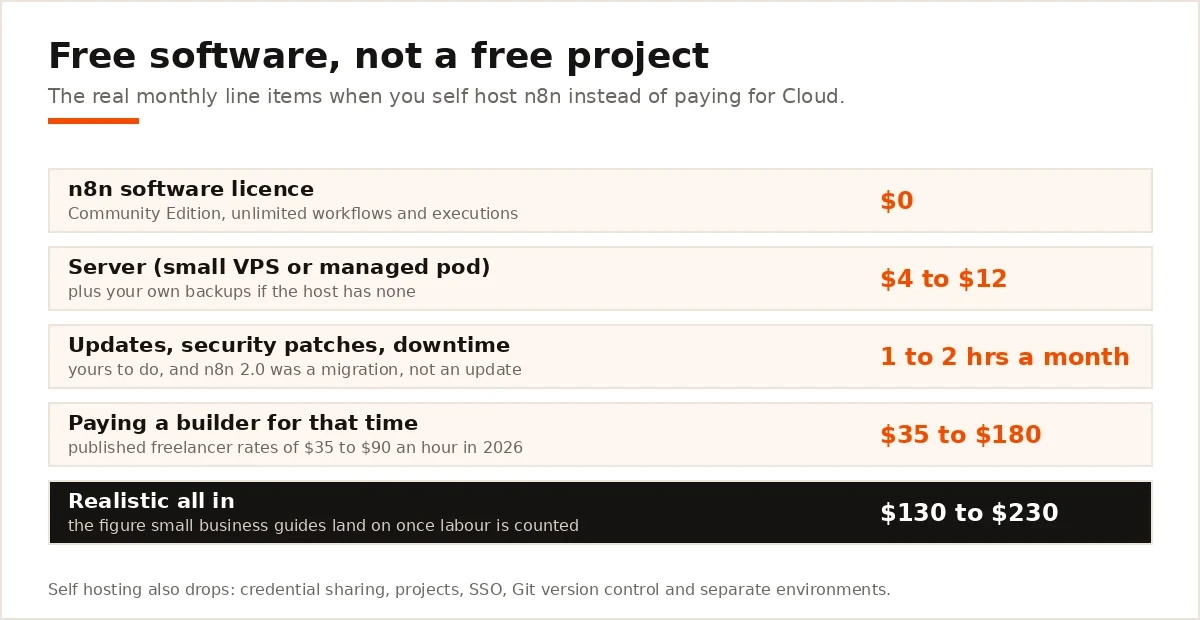
A $6 VPS plus a couple of hours a month is a fair budget where someone capable owns it. Backups, TLS, updates and the withheld features, credential sharing, projects, SSO, Git and environments, are the price of that $6.
What it costs to have it built and kept running
Plenty of small businesses should not build these flows themselves, and there is nothing shameful about paying. Published 2026 rate cards give a wide range because the phrase covers a first-year freelancer and a boutique agency alike.
| Work | Published 2026 range | What to check before signing |
|---|---|---|
| Single simple Zap, trigger to one action | $300 to $800 | Who owns the account and the credentials afterwards |
| Multi-step business workflow with branching | $800 to $3,000 | Error handling, duplicate protection and a written handover |
| n8n workflow with API, database and self-hosting | $2,500 to $7,500 | Backup plan, update routine, documented runbook |
| Specialist hourly, Zapier | $40 to $125 | A cap on hours, and a fixed price for the build |
| Specialist hourly, n8n or AI automation | $35 to $160 | Whether monitoring and fixes sit inside the rate |
| Monthly retainer for upkeep and new flows | $700 to $8,000 | Response time, and what counts as an emergency |
One number matters more than the low end of those ranges: a $1,500 workflow that needs thirty minutes of care a month costs more in a year than the n8n plan it runs on. Price ownership up front, or you will hear about it in month four. My contact page asks for the two workflows you would automate first.
Running both tools is a normal answer
The most common ending to an n8n vs Zapier for small business argument is both. Sales and marketing keep niche one-off Zaps, since rebuilding those elsewhere costs hours, while finance, fulfilment and support run high-volume flows in n8n, where a 12-node loop is still one execution.
Keep the handover clean or the second tool becomes a rumour: one naming convention for records, a single queue between them, usually a webhook or a table row. And do not migrate for the sake of it. Zapier has no exporter, so rebuilding 60 Zaps in n8n runs to 20 to 40 minutes each, filters and error handling included.
Three questions that settle it
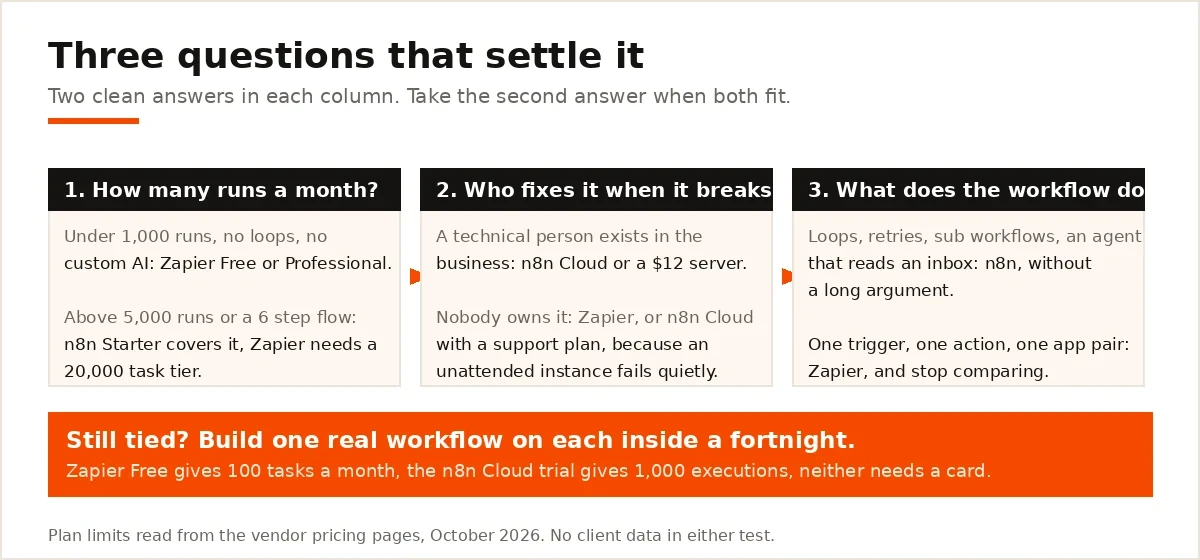
Answer them in writing before you sign up for anything, because the honest answer to most of them is 90 minutes of reading a pricing page and one test workflow. Every table above exists to make that hour shorter, not to replace it.
Common questions about n8n vs Zapier for small business
Is n8n cheaper than Zapier for a small business?
Usually, once a workflow has more than two steps or runs past about a thousand times a month. n8n bills one execution per run whatever it contains, while Zapier bills a task per action step. At 2,000 runs of a four step flow, list prices put n8n Cloud at $20 and Zapier near $89 to $129.
Is n8n harder to learn than Zapier?
For most non-technical people, yes. Zapier walks you through a trigger and actions in a fixed order, while n8n hands you a canvas, JSON paths and expressions. Budget a few evenings before a production workflow feels safe, because that learning curve costs more in a year than the price gap.
Can n8n replace Zapier completely?
For most workflows, yes. n8n has around 400 native nodes, and its HTTP Request and Code nodes reach anything with a documented API. The long tail is the gap: Zapier listed 10,247 apps in October 2026, so niche SaaS often has a maintained connector there and nothing in n8n.
Is self-hosted n8n safe for customer data?
It can be, since data stays on infrastructure you control and you set retention. The free Community Edition includes an encrypted credential store but not SSO, audit logs or Git, and every patch, backup and certificate is your job. Without someone to own that, use n8n Cloud or Zapier.
Which is better for AI agents and chatbots?
Zapier is faster for light, governed AI work, with Agents, Chatbots, Canvas and MCP on a published activity meter. n8n suits agents that need chosen models, memory, retrieval and approval gates, since you wire the graph and pay only the model provider.
How to test this without paying for a year
Run one workflow for two weeks on both tools with the same real data, which is the only honest way to settle an n8n vs Zapier for small business budget. Pick the flow that annoys you most today, usually one that touches a spreadsheet and a human twice, and count what you actually burn rather than what you guess.
Write the failure plan while you are in there: who gets the alert, who fixes it, what happens to a duplicate lead. The tool you keep is the one your team can still operate in month seven, which is why I push clients toward boring integrations in the platform ownership section of my Shopify guide.
If the arithmetic says Zapier, buy Professional, use the free steps shamelessly and stop reading. If it says n8n and the server talk makes you nervous, that is where a build partner earns a fee. Send me the two flows and I will say honestly whether you need me, or a $20 plan and a weekend.
Sources and the date I read them
Prices and limits were read on 16 October 2026 from: Zapier plans and pricing, Zapier task usage rates, the Zapier app directory, n8n plans and pricing and the n8n docs for editions and Community Edition limits. Make figures came from three independent 2026 guides and consultant ranges from published rate cards, so treat those as market ranges, not quotes.
Last reviewed 16 October 2026. Vendor prices and plan limits move, so re-check the pricing pages before you sign anything.