
Most advice about ad budgets is written in dollars that are not ours, by people who have never watched an owner open the account on a Tuesday and find the money gone by Thursday. A Google Ads budget for Australian small business has to be built instead from local click prices, what management really costs from Perth to Sydney, the GST line most quotes skip, and your own margin.
I run accounts for small businesses, usually one service, one city and one owner answering the phone between jobs. Every figure here is testable inside a month.
Start here. One service in one city needs about $1,500 a month in ad spend. At 2026 Australian click prices that is 300 to 600 clicks and 12 to 30 enquiries if your page converts at 5%. Add $800 to $2,000 if somebody else runs it.
Below that. $500 a month is a test, not a campaign. Enough data to kill a bad keyword list, not enough to feed automated bidding, which wants about 30 conversions a month.
Above that. $3,000 a month is where a second service line, a wider metro or a field like legal starts to work rather than merely run.
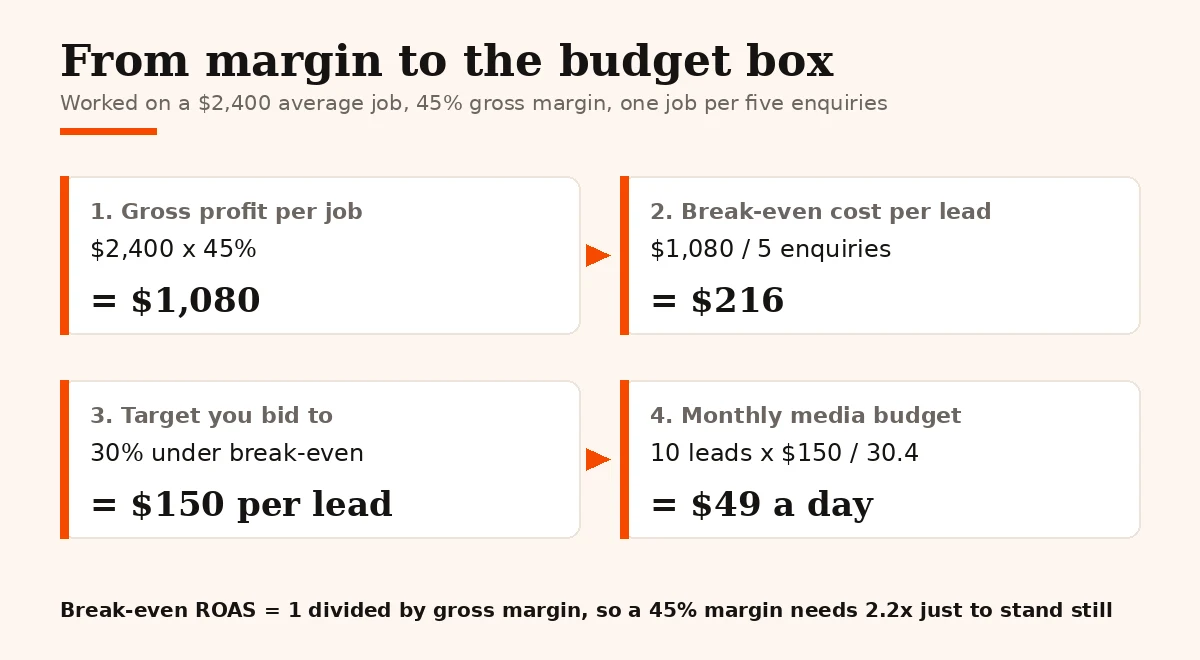
The number that decides it. Your margin. A 40% gross margin needs 2.5x return on ad spend to stand still, so the question is really how many enquiries you can answer profitably this month.
What this guide covers
- The short version, in one table
- What the daily budget box actually controls
- Google Ads cost per click Australia, the 2026 spread
- Work backward from your margin, not a benchmark
- Four budgets, and what each one really buys
- Google Ads management fees in Australia
- Five line items nobody puts in the quote
- What changed in 2026 that moves your number
- Australian seasonality and when to fund the account
- A six week plan for a first $1,500 month
- When Google Ads is the wrong spend
- Common questions about a Google Ads budget for Australian small business
- Your number, on one page
The short version, in one table
A starting grid, not a promise. Clicks assume $2.50 to $5.00, where most accounts outside legal and marketing sit.| Monthly ad spend | Clicks at 2026 rates | Enquiries at 4% to 6% |
|---|---|---|
| $500 | 100 to 200 | 4 to 12 |
| $1,500 | 300 to 600 | 12 to 36 |
| $3,000 | 600 to 1,200 | 24 to 72 |
| $5,000 | 1,000 to 2,000 | 40 to 120 |
What the daily budget box actually controls
The field labelled average daily budget is not a cap. Google may spend up to twice it on a single day, and caps billing monthly at 30.4 times it. So $50 in the box means $100 on your worst day and $1,520 for the month. Plan against the monthly number. Decide what you will spend, divide by 30.4 and put that in the box, so a $1,500 month means setting $49. A 2026 change sharpens this. From 1 June Google paces to the full monthly limit even on ad schedules, squeezing the month into only the days you allow. A Monday to Friday campaign that used to land near $1,100 now aims at all $1,520 across about 22 days. Write the monthly ceiling inside the account and change the budget no more than once a week while you learn.Google Ads cost per click Australia, the 2026 spread
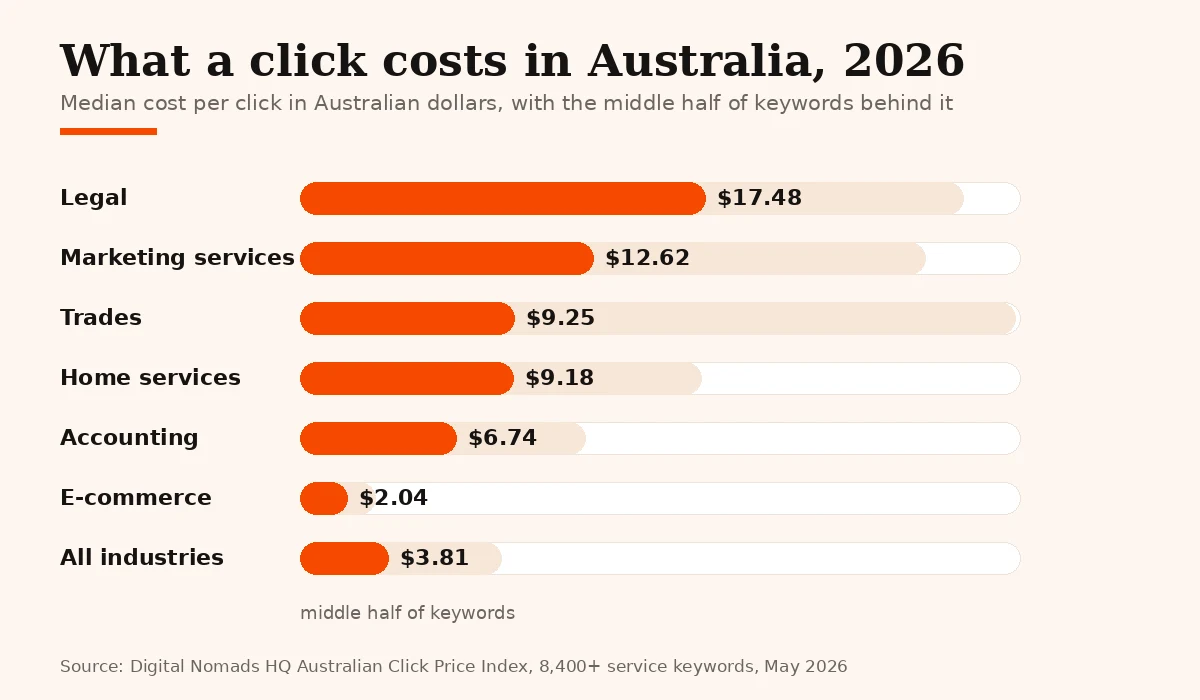
Google publishes no national average CPC, only Keyword Planner ranges, so every benchmark is somebody measuring their own accounts. Two Australian sets are worth reading, the Digital Nomads HQ index of over 8,400 service keywords, and Firewire Digital’s 25 managed accounts.| Category | Median CPC (AUD) | Middle half | Movement to mid 2026 |
|---|---|---|---|
| Legal | $17.48 | $9.83 to $28.57 | up 18% |
| Marketing services | $12.62 | $5.91 to $26.92 | up 27% |
| Trades | $9.25 | $2.85 to $30.82 | up 10% |
| Home services | $9.18 | $3.86 to $17.30 | up 19% |
| E-commerce | $2.04 | $1.26 to $3.24 | up 27% |
| All industries | $3.81 | $1.73 to $8.66 | up 21% |
Work backward from your margin, not a benchmark
Return on ad spend is revenue from ads divided by ad spend. Break-even ROAS is 1 divided by gross margin, where margin means revenue minus every cost that scales with the sale, product, fees, packaging, shipping you absorb.| Gross margin | Break-even ROAS | Target ROAS to keep 10% profit |
|---|---|---|
| 30% | 3.33x | 5.00x |
| 40% | 2.50x | 3.33x |
| 50% | 2.00x | 2.50x |
| 60% | 1.67x | 2.00x |
| 80% | 1.25x | 1.43x |
Four budgets, and what each one really buys
$500 a month, a probe not a launch
You are buying one ad group, one service and two weeks of data. It answers a narrow question, does anyone in Parramatta search for emergency air conditioning repair on a Sunday, and it fails as a growth plan.$1,500 a month, the sensible floor
The number I suggest most owners start with, and it lines up with what Australian guides published for a small account in 2026, $1,000 to $2,500. It funds real negative keywords, one page you will actually rewrite, and enough conversions to learn in six weeks.$3,000 a month, when competition is genuine
Two metros, a longer service list, or any field where the middle half of keywords clears $9 a click. Expect weekly optimisation and a call, not a monthly PDF.$5,000 and up, capacity decides
Above this the constraint is rarely Google. It is whether someone answers inside five minutes, because enquiry to quote rates fall when a lead waits until evening.Google Ads management fees in Australia
For many small businesses the fee is the larger half of the quote, and the model tells you where the incentives sit.| Model | Typical 2026 range (AUD) | Where it goes wrong |
|---|---|---|
| Flat monthly retainer | $800 to $2,000 small, $1,500 to $5,000 complex | Some cover reporting only, so ask what work is included |
| Percentage of spend | 10% to 20%, often tiered | Your manager earns more when you spend more, whatever happens |
| Hourly | $60 to $250 | Fine for an audit, expensive as a habit |
| One-off setup | $750 to $2,000 | Some shops build and never optimise again |
Five line items nobody puts in the quote
- GST. Google Australia Pty Limited bills Australian accounts with 10% GST on ad spend, and agency fees are usually quoted plus GST. A $1,500 month of media is $1,650 before the fee. Registered businesses can generally claim it back, everyone else pays 10% more for advertising.
- The landing page. Traffic sent to a homepage is the commonest way a decent budget dies. One page with the service, the suburb and a form is two to five hours of work, call it $200 to $600, and it is not in the media budget.
- Tracking. Importing GA4 and counting form fills is an hour. Doing it properly, with enhanced conversions so bidding sees jobs booked rather than thank-you pages, is half a day.
- Search term upkeep. Since the September 2026 AI Max changes more spend can land on related queries, so somebody must read the search terms report weekly and add negatives.
- Lead response. An enquiry nobody answers in five minutes is a click you paid for twice.
What changed in 2026 that moves your number
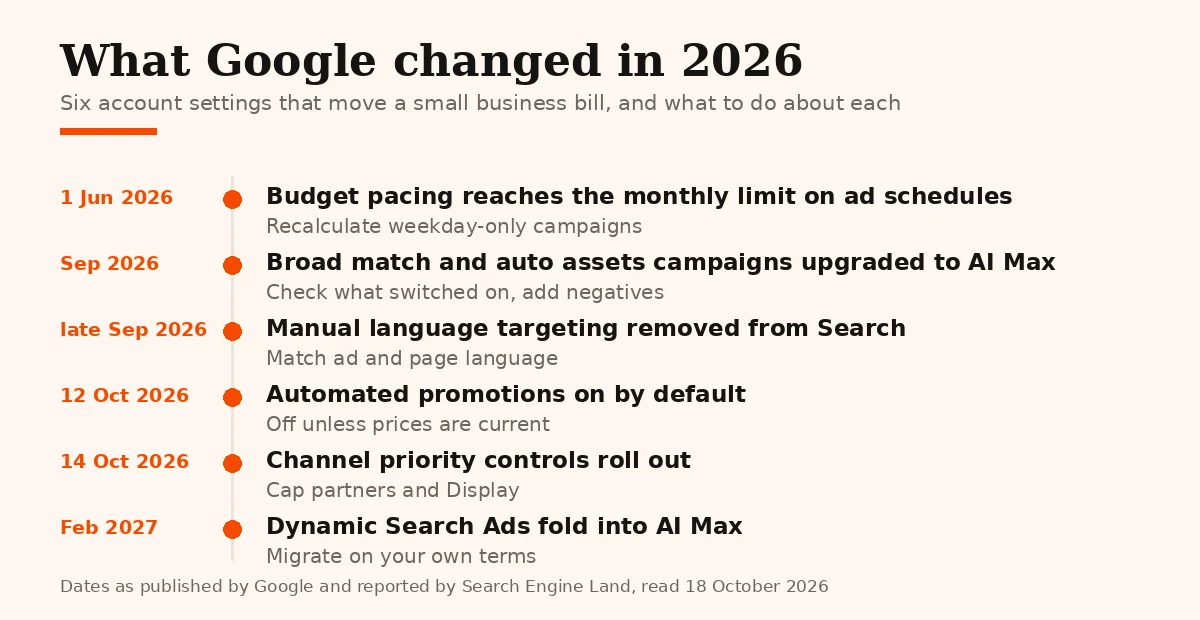
| Change | When | What to do |
|---|---|---|
| Budget pacing now reaches the full monthly limit on ad schedules | 1 June 2026 | Recalculate any Monday to Friday campaign before you raise anything |
| Campaigns using campaign-level broad match or automatically created assets upgraded to AI Max | 1 to 30 September 2026 | Open each campaign, see what switched on, tighten negatives |
| Manual language targeting removed from Search | late September 2026 | Match ad copy and landing page language to the audience you want |
| Automated promotions on by default in eligible campaigns | 12 October 2026 | Switch it off unless your prices are current everywhere |
| Channel priority controls for Search, Shopping, Performance Max and Demand Gen | from 14 October 2026 | Mark Search partners or Display low priority if lead quality is the issue |
Australian seasonality and when to fund the account
A budget that ignores the calendar buys peak prices in a weak campaign, and the last ten weeks of the Australian retail year are stacked.- EOFY runs to 30 June and is strong for anything a business writes off, so B2B and equipment sellers want live campaigns by May.
- Afterpay Day held 19 to 22 March and 13 to 16 August in 2026, a four day spike worth funding for retail.
- Click Frenzy’s Main Event moved to 27 to 30 October after the brand changed hands, and Black Friday fell on 27 November, with Australia Post measuring around $1.5 billion spent online across that weekend.
- January and February are the cheapest months to buy data, which makes them the best time to build what you scale in November.
A six week plan for a first $1,500 month
- Week 1, one campaign, five tight ad groups at most, exact and phrase match, one page with the service, the suburb and a single form.
- Week 2, spend without touching anything except the conversion check.
- Week 3, read search terms, cut the ten worst queries as negatives and kill any ad group with no conversion.
- Week 4, test one headline set and move your best $200 of spend into a tighter list.
- Week 5, judge by cost per enquiry, not clicks. A working test sits inside 1.5 times your break-even cost.
- Week 6, write down enquiries, their cost and how many became quotes. That is next quarter’s budget.
When Google Ads is the wrong spend
Four situations where I tell an owner to keep the budget and spend it elsewhere.- Your margin cannot carry the click, a 20% reseller in a $9 field is bidding for the right to lose money.
- Nobody can answer quickly. Trades and clinic leads go cold inside an hour, and paid traffic only tests your response time.
- The volume is not there. If your core term shows low hundreds of searches a month nationally, you exhaust the market in nine days and blame the channel.
- You sell on trust over months, where content, referrals and remarketing usually outperform a search budget.
Common questions about a Google Ads budget for Australian small business
The five below are the ones owners ask on the first call.How much should a small business spend on Google Ads in Australia?
For one service in one city, $1,500 a month in ad spend is a defensible start, plus $800 to $2,000 if an agency runs it. That buys roughly 300 to 600 clicks at 2026 Australian rates. Treat $500 as a two week test, and treat $3,000 as the level where multiple services or real competition make sense.
Is $500 a month enough for Google Ads?
Enough to learn, not enough to grow. You will see which queries convert and whether your offer earns clicks, usually within two weeks. Automated bidding wants about 30 conversions a month, which $500 rarely delivers outside a cheap category, so expect to optimise by hand at that level.
What is a good cost per click in Australia?
Across Australian service keywords the 2026 medians sit near $3.81, with the middle half of terms between $1.73 and $8.66. Legal, marketing and trades run higher, e-commerce lower. A good CPC is the one your margin survives, which you can work out from gross profit per job and your close rate.
Do I pay GST on Google Ads spend?
Yes. Google Australia Pty Limited bills Australian accounts with 10% GST on ad spend, and local agencies usually quote fees plus GST. If you are registered you can generally claim it as an input tax credit on your BAS, and if you are not, the 10% is simply part of the cost of advertising.
Should I hire an agency or run it myself?
Run it yourself while spend sits under about $1,500 a month, because a median fee near $1,250 would double your cost. Buy a setup, a tracking build or a monthly review instead of a retainer, then move to ongoing management once a bad week on the account costs more than the fee.
Your number, on one page
There is no right Google Ads budget for Australian small business owners in general, and a figure from a US deck will not survive contact with a Sydney auction. There is only the number your margin can carry and your capacity can answer.
Write down three things before you open an account, gross profit per job, the share of enquiries that become jobs, and how fast you respond to one. Your break-even cost per lead falls out of that, and the budget is that number times the leads you can handle.
If you want a straight read before you commit to a retainer, send me those three numbers and I will tell you honestly whether this channel is the right buy. That first call is free and takes 20 minutes.
Sources and the date I read them
Read on 18 October 2026 from Google Ads Help on average daily budgets and spending limits; Google Ads Help on taxes, including GST on Australian accounts; Digital Nomads HQ Australian Click Price Index, May 2026; Firewire Digital, 25 managed Australian Search accounts to September 2026; Audit of published prices from 180 Australian agencies, June 2026; Search Engine Land on the AI Max migration timeline; ACMA guidance on commercial messages under the Spam Act 2003. Benchmark tables are medians from the publishers named rather than Google’s own reporting, so treat them as market ranges, not quotes.
Last reviewed 18 October 2026. Click prices, platform settings and agency fees move, so re-check your own account data before you commit a quarter of spend.